Edge AI on FPGAs: Hardware Selection and Deployment Strategies
Edge AI on FPGA: Hardware Selection and Deployment Strategies
Training a model in the cloud with high accuracy is the easy part. The hard part is running that same model on an edge device under 5 watts and with sub-10 millisecond latency.
Standard 32-bit floating-point (FP32) models are inherently greedy: they demand high memory bandwidth and intensive computation; which makes them impractical for most battery-powered edge hardware. Yet, moving AI from the cloud to the edge is no longer an option. It is a structural necessity in systems requiring data privacy, offline operability, and ultra-low latency.
At this point, hardware selection is the most critical decision determining whether the system is viable. While edge GPUs and TPUs are common; the FPGA is a powerful alternative in applications requiring deterministic latency, customizable datapaths, and the best performance per watt. However, integrating an AI model into an FPGA requires systematic management of hardware resource constraints.
In this article, we discuss the architectural advantages of the FPGA for edge inference, the inherent challenges of resource constraints, and how we at RunX approach these bottlenecks with hardware-aware quantization and hardware-software co-design.
1. Edge AI System Requirements
Relying on cloud-based inference in industrial automation, autonomous robotics, and high-speed computer vision leads to latency jitter that can disrupt real-time control loops. Sending high-resolution frames to the cloud over a network just to obtain a few spatial coordinates is fundamentally inefficient for time-critical systems.
Edge AI eliminates this problem by localizing processing. But edge hardware operates under strict physical limits: constrained thermal dissipation (often forcing fanless designs) and tight power envelopes (frequently under 5 watts). The processing unit must be able to take raw sensor data, such as MIPI CSI-2 camera streams, and execute neural network inference in a single, high-speed pipeline.
Standard microcontrollers cannot handle this parallel processing load. General-purpose edge GPUs, on the other hand, struggle to maintain deterministic latency and consume considerable power to feed an operating system. The FPGA is designed precisely targeting these constraints.
2. Architectural Advantages of the FPGA
The FPGA provides four fundamental advantages for running neural networks at the edge:
- Deterministic latency: Unlike GPUs relying on dynamic thread scheduling and complex memory hierarchies, the FPGA allows you to build deterministic hardware pipelines. Processing occurs in precise and predictable clock cycles. Indispensable for tasks requiring high-speed synchronization.
- Customizable datapaths: Traditional processors route data through predefined 32/16/8-bit ALUs. The FPGA allows you to synthesize the datapath at the exact bit-width the model requires. If a network operates best with 4-bit weights and 5-bit activations, the hardware is tailored exactly to those dimensions, and silicon waste is eliminated.
- Direct sensor data ingestion: High-bandwidth interfaces can be terminated directly within the FPGA fabric. Preprocessing tasks like color space conversion are performed in hardware logic, and the result is fed directly to the accelerator. This bypasses external DDR memory, significantly lowering both power and latency.
- Hardware adaptability: Deep learning changes rapidly. An ASIC is fixed once manufactured; the FPGA, however, can be reconfigured in the field to support new network topologies and activation functions.
3. The Hardware Resource Constraint Problem
Despite this architectural suitability, mapping a modern CNN onto an FPGA carries significant technical complexity.
Models trained in PyTorch or TensorFlow natively use FP32. Building FP32 multipliers inside an FPGA consumes excessive logic resources; storing millions of FP32 parameters requires high memory capacity.
Edge-class FPGAs are restricted by limited on-chip memory (BRAM/UltraRAM) and a finite number of DSP slices. The moment model parameters exceed the on-chip BRAM capacity, the system is forced to continuously fetch data from external DDR. This bandwidth limit creates a severe bottleneck. Because at the edge, the energy cost of data movement often exceeds the cost of computation.
The conclusion is clear: running edge AI effectively on an FPGA requires aggressive model compression techniques that preserve accuracy.
4. Quantization for Resource Optimization
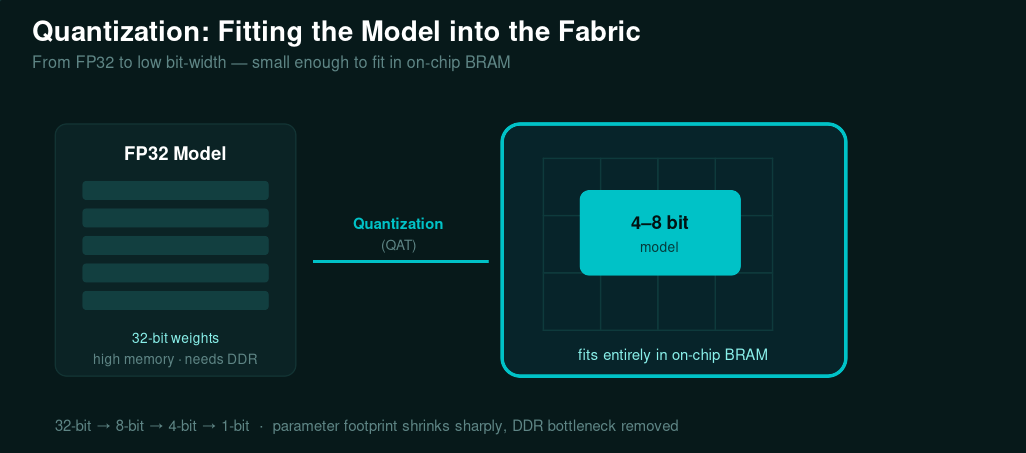
The fundamental technique of structural model compression is quantization: converting weights and activations from 32-bit floating point to lower bit-width integers.
There are two main methods:
- Post-Training Quantization (PTQ): Reduces the precision of an already trained FP32 model. It is cheap to apply, but often leads to significant accuracy loss when applied to complex architectures or very low bit-widths (e.g., 4-bit).
- Quantization-Aware Training (QAT): Simulates low precision during training. Because the network algorithmically adapts to quantization noise during training, it maintains its accuracy even at very low bit-widths.
For FPGA architectures, the optimum strategy is QAT. It enables 4-bit, 2-bit, and even 1-bit (Binary Neural Networks - BNN) precision. By minimizing the parameter footprint, it allows the entire model to be stored in the FPGA’s internal BRAM; thus, the DDR bottleneck is eliminated, and inference throughput is maximized.
5. Hardware-Aware Quantization Approach
Generic quantization frameworks often fall short in optimizing for the specific microarchitectural constraints of the target accelerator. What is critical is designing the quantization not as a hardware-agnostic post-processing step, but alongside the target FPGA’s resource budget.
At RunX, we apply a hardware-aware QAT approach in this domain: we provide the concrete logic, memory, and DSP budget of the target FPGA as inputs to the training loop, compressing the model into varying bit-widths (from 1-bit to 8-bit) on a per-layer basis. Thus, a standard CNN transforms into a power-efficient model tailored to that hardware; because critical weights can be kept in on-chip BRAM, the DDR bottleneck is eliminated.
This approach allows for mixed-precision strategies: while feature extraction layers are aggressively quantized (e.g., 4-bit), more sensitive layers like classification can be kept at higher precision (e.g., 8-bit). This is the practical way to minimize resource consumption while maintaining accuracy.
6. Deployment Architecture
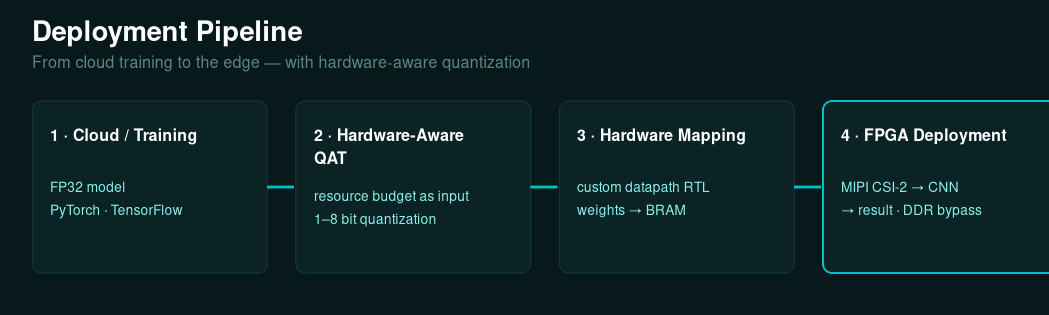
The pipeline that moves the model from the cloud training environment to edge hardware operates in four stages:
- Cloud / Training: The FP32 model is trained with PyTorch/TensorFlow.
- Hardware-Aware QAT: The target FPGA’s logic/BRAM/DSP budget enters the training loop; the model is quantized at variable bit-widths (1–8 bit).
- Hardware Mapping: The quantized model is converted into custom datapath RTL synthesized to the exact bit-width; weights are placed into on-chip BRAM.
- FPGA Deployment: MIPI CSI-2 → hardware preprocessing → CNN accelerator → result; the entire flow executes on-chip, bypassing DDR.
7. Conclusion
Running AI models on an FPGA is inherently a hardware-software co-design process: it requires combined expertise in RTL design, timing closure, memory architecture optimization, and deep learning mathematics.
At RunX, we leverage our own IP cores, hardware-aware quantization approaches, and broad hardware engineering experience for robust edge AI systems. Whether you are optimizing an existing neural network for an edge processor or designing a custom FPGA architecture from scratch; we provide the theoretical and practical foundation needed to hit strict performance and efficiency targets.
You can contact our engineering team to discuss technical requirements and deployment strategies for your upcoming projects.
Contact us: info@run-x.com | www.run-x.com