Why FPGAs? The Chip That Reshapes Itself for the Job
Imagine you’re building a radar system, a 5G base station, or a trading engine that has to react in millionths of a second. All three need to chew through huge amounts of data with zero room for delay. You’ve basically got three silicon options: a general-purpose CPU, a small microcontroller, or something built specifically for the job an FPGA.
An FPGA (Field-Programmable Gate Array) ships blank. Instead of software running on fixed hardware, you configure the hardware itself wiring it, at the circuit level, into exactly the machine your application needs. Don’t like the result, or does the application change next year? Reconfigure it again. You get custom silicon without ever committing to custom silicon.
So CPU, FPGA, or Microcontroller?
None of these chips wins at everything, and that’s the point: each one trades away something to be great at something else. Here’s a simple scorecard 3 points for whichever option is best in a row, 2 for the middle, 1 for the lowest:

A CPU is the easiest and fastest to develop for, and a microcontroller is the cheapest to put in a product but neither one gives you nanosecond-level determinism or lets you reshape the actual hardware after it’s built. That’s the FPGA’s lane: it costs more silicon and takes longer to design for, but nothing else lets you reuse the same chip across wildly different applications while still hitting hardware-level timing guarantees.
Where FPGAs Actually Show Up
- 5G & wireless infrastructure real-time beamforming and protocol processing across massive antenna arrays, at radio speed.
- Radar & sensor signal processing filtering and correlating raw sensor data fast enough for the result to still matter.
- High-frequency trading decision loops measured in nanoseconds, where a general-purpose CPU’s jitter alone can cost money.
- Video & computer vision real-time encoding, decoding, and vision pipelines running at the edge, not in the cloud.
- AI inference acceleration custom, low-power inference pipelines that can beat general-purpose GPUs on latency-per-watt for a fixed model.
- Aerospace & defense systems mission hardware that has to be reconfigurable years after it’s already been deployed in the field.
How Does an FPGA Actually Pull This Off?
Underneath all of it, an FPGA is built from thousands of tiny reconfigurable logic cells wired together through a massive, fully programmable routing fabric. Instead of running instructions one at a time like a CPU does, an FPGA lays your entire algorithm out as physical, parallel hardware every piece doing its own job, at the same instant, every clock cycle.

Sprinkled through that fabric are hundreds of hard-wired DSP blocks for math and BRAM blocks for on-chip memory. Because there can be so many of each, spread across the chip, an FPGA can run hundreds of multiply-accumulate operations and memory accesses simultaneously not faster instructions, but genuinely parallel ones. That’s the real trick: an FPGA isn’t a quicker CPU. It’s a different way of computing altogether custom-built, in hardware, for exactly the job you hand it.
Some important FPGA elements:
LUT: The tiny cells that are able to perform custom functions all on their own.
Routing Matrix: The real magic of FPGAs. These elements determine which cell connects to which.
Block Memory (BRAM): The small amount of memory element that can be used in a flexible way.
DSP: The element that is able to perform multiplication and addition without costing LUTs and routing.
Zoom into that flexible slice and it’s really just two things doing the work: LUTs and routing. A LUT is a tiny piece of memory that can be configured to output whatever logic result you need for a given set of inputs reprogram that memory, and the same piece of silicon becomes a different logic function.

Routing is what turns thousands of these small, configurable pieces into one coherent circuit: a dense mesh of programmable wires and switches that can connect any LUT to any other, in whatever pattern your design calls for. Put the two together and the chip isn’t just fast it’s shaped. Instead of forcing your application to run as generic instructions on generic silicon, the hardware itself gets rewired into the specific circuit your application needs, right down to the gate level.
FPGAs in the AI Era
Something’s shifted in the last couple of years that makes all of this more relevant, not less: the “takes longer to design for” line in that scorecard is quietly getting shorter. AI-assisted design tools are eating into the parts of FPGA development that used to make it a specialist’s game RTL that used to take a week of careful, error-prone hand-coding can get a working first draft in an afternoon; verification environments, driver code, and documentation that used to eat as much schedule as the design itself are now something you generate, review, and fix in the same sitting.
It’s tempting to read that as “AI makes hardware matter less” enough software cleverness, and eventually the chip underneath stops mattering. It doesn’t, because AI is compressing design time, not physics. A CPU still runs one instruction stream through a fixed pipeline; a GPU still burns a chunk of its power budget on scheduling and memory movement that has nothing to do with your actual computation. No model changes what a fixed piece of general-purpose silicon can physically do in a nanosecond, on a fixed power budget. The hardware ceiling that made a purpose-built FPGA worth the trouble real parallelism, deterministic timing, a power-per-operation number general-purpose silicon can’t touch hasn’t moved.
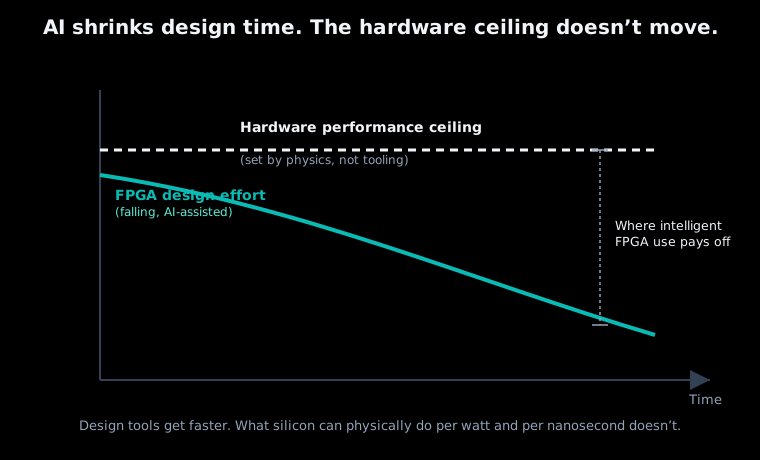
Put the two together and you get a lopsided shift: the FPGA’s traditional cost design time is falling, and its traditional benefit hardware-level performance hasn’t changed at all. That makes knowing when a workload genuinely needs custom, parallel hardware, rather than another layer of software on general-purpose silicon, more valuable, not less. It also closes a loop this article already opened: AI inference is exactly the kind of fixed, latency- and power-sensitive workload an FPGA is built to accelerate. The same wave making FPGAs faster to design is also producing more of the workloads worth designing them for.