DMA/VDMA IP
Introduction
The RunX DMA/VDMA IP is a programmable-logic core that moves data between memory and AXI4-Stream interfaces under register control. One RTL tree builds either a descriptor-style DMA engine or a continuous frame-streaming VDMA engine, selected by a single synthesis-time generic, and the two builds present a byte-for-byte identical register map, so one software image drives either bitstream and switching modes on a running board is a bitstream reload with no reboot and no driver change. The RTL uses no vendor primitives. A processor-based system is one common application, and RunX supports that case directly, with ready-made C drivers, a reference design and scripted builds. This page summarises the core; the datasheet and user guide are the full specification.
Features
-
One RTL tree, two build variants: DMA mode and VDMA mode, selected by synthesis-time parameter.
-
Identical register map in both builds; one software image serves either modes.
-
Configurable for up to 32 write and 32 read AXI4-Stream channels, 128-bit data path.
-
Fixed-offset register map with a read-only identification and capability header, so one driver works with any build.
-
Multi-outstanding AXI4 read and write engines shared by all channels.
-
VDMA mode: shadowed frame geometry with commit-and-validate, SOF/EOL framing, multi-frame buffering.
-
Optional hardware performance counters, so bandwidth is measurable from software without an ILA.
-
Key-protected soft reset with an AXI quiesce phase and per-stream resets.
-
Measured on hardware at 97.5 to 99.8 % of the datapath limit, in every direction and at every clock tested on hardware.
-
Vendor-agnostic RTL: no vendor primitive, library or attribute; built unmodified on Vivado, Quartus Pro, Radiant and Libero.
IP Block Diagram
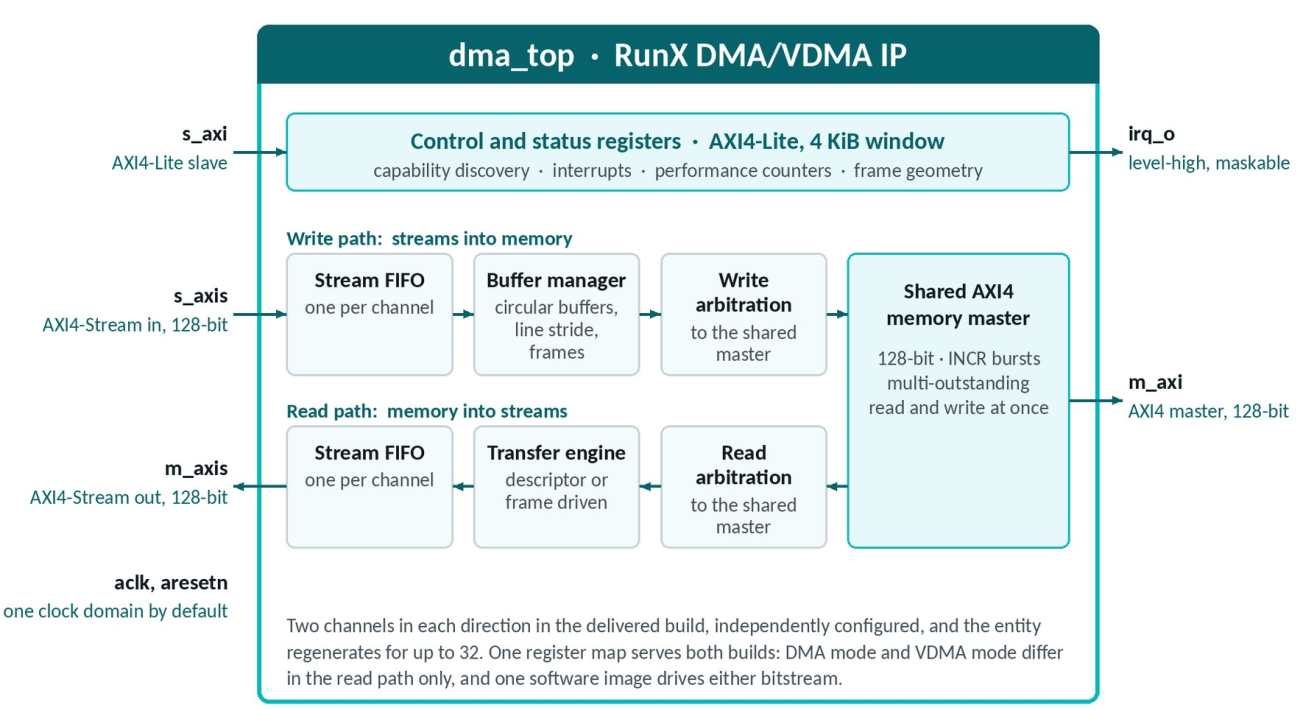
The core exposes an AXI4-Lite slave (s_axi) for control and status, AXI4-Stream input (s_axis) and output (m_axis) ports, a 128-bit AXI4 memory master (m_axi), a level-high maskable interrupt (irq_o) and one clock and reset pair (aclk, aresetn) by default. On the write path, streams pass through a per-channel stream FIFO, a buffer manager and write arbitration to the shared AXI4 master. On the read path, a descriptor- or frame-driven transfer engine and read arbitration feed per-channel stream FIFOs.
Maximum Frequency Table
| Vendor | Device | DMA | VDMA |
|---|---|---|---|
| Xilinx / AMD | Zynq UltraScale+ xczu7ev-3 | 335.0 MHz | 379.7 MHz |
| Altera / Intel | Stratix 10 1SG040-1 | 196.5 MHz | 285.4 MHz |
| Xilinx / AMD | Kintex-7 xc7k70t-1 | 130.4 MHz | 197.5 MHz |
| Lattice | Avant-E / Avant-X 70-3 | 117.0 MHz | 154.5 MHz |