SD Host Controller IP
RunX SD Host Controller IP
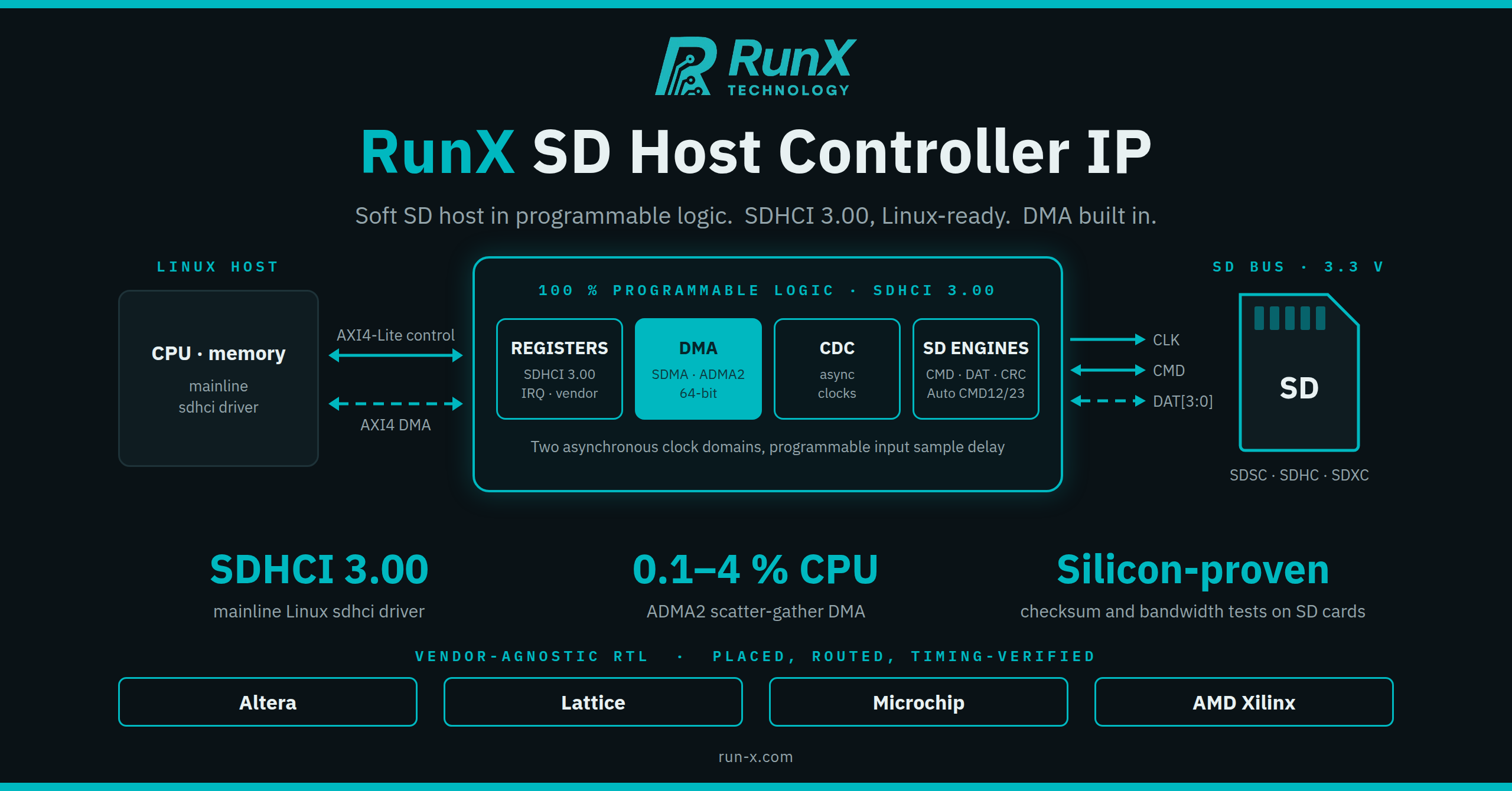
SDHCI 3.00 compatible SD card host with built-in SDMA / ADMA2 DMA. Runs with the standard Linux sdhci driver on Altera, Lattice, Microchip and AMD Xilinx FPGAs.
Highlights
- SDHCI 3.00: Standard register set; the generic Linux sdhci driver runs it with no quirks.
- ADMA2: Built-in SDMA and ADMA2 DMA with 32- and 64-bit addressing over AXI4.
- 25 MB/s: Full 4-bit High Speed bus rate with ADMA2 at 0.1–4 % CPU load.
- 4 vendors: One SystemVerilog RTL for Altera, Lattice, Microchip and AMD Xilinx.
Overview
The RunX SD Host Controller connects an SD memory card to an FPGA system. Software sees a standard SD Host Controller (SDHCI 3.00) on an AXI4-Lite slave, so Linux mounts the card through its generic sdhci driver and a small platform glue; no custom driver is needed.
The built-in DMA engine moves data between the card and system memory over an AXI4 master while the CPU stays almost idle. The same RTL targets every supported FPGA family, with no vendor primitives inside. The core is proven under Linux with real SD cards.
Why RunX
- Standard, not custom: SDHCI 3.00 registers, so the mainline Linux sdhci driver does the work.
- Vendor-independent RTL: One SystemVerilog code base across four FPGA vendors; tri-state buffers stay in your top level.
- DMA included: SDMA and ADMA2 in the core, no separate DMA IP to integrate.
- Board timing tuning: Programmable input sample delay for the SD bus.
Built to Be Trusted
- Proven Design: Linux mount and checksum-verified file copies on real SD cards.
- Full bus rate: 25 MB/s in 4-bit High Speed with ADMA2 at 0.1–4 % CPU, against about 99 % with PIO.
- Two simulators: Questa and Vivado xsim, full functional coverage and constrained-random regression.
- Clean error handling: AXI bus errors stop the job and report channel, response and failing address.
Features
Host Interface
- SD Host Controller Standard 3.00 register set (version 0002h) on a 4 KB AXI4-Lite window; byte, word and dword access
- Level interrupt and wake output; Force Event registers for error injection
- Vendor block: IP version, build configuration, input sample delay and DMA error diagnostics
DMA Engine
- SDMA and ADMA2 with 32- and 64-bit addressing; 8- and 12-byte descriptors (Tran, Link, Nop)
- AXI4 master with INCR bursts up to 16 beats, never crossing 4 KB
- Optional by parameter: a PIO-only build for the smallest footprint
SD Bus
- SDSC, SDHC and SDXC cards; 1-bit and 4-bit bus
- Default Speed (25 MHz) and High Speed (50 MHz) at 3.3 V signalling
- Auto CMD12 and Auto CMD23; Stop At Block Gap and Continue; any block size
- Card detect with debounce and polarity, write protect, power enable, activity LED
Software
- Linux platform glue driver for the generic sdhci driver (kernels 5.15 to 7.x, GPL-2.0)
- Device tree binding example
- Register-level bring-up and test script
Supported FPGA Vendors
- Altera
- Lattice
- Microchip
- AMD Xilinx
Resource Utilization
| Configuration | LUTs | Registers | Block RAM | DSP |
|---|---|---|---|---|
| PIO only (DMA disabled) | 1,673 | 2,845 | 1 | 0 |
| SDMA + ADMA2, 64-bit address | 3,560 | 4,810 | 1 | 2 |
AMD Zynq UltraScale+ XCK26, Vivado 2025.2, out-of-context synthesis, 100 MHz on both clocks, 4-bit SD bus, 512-byte blocks. Block RAM in 36 Kb tiles.
Available Now
- IP core
- Register map
- Linux driver and bring-up script
- Datasheet and user guide
- Reference design
- Verification summary
- Integration and technical support
Evaluation, Pricing and Licensing
Contact us at info@run-x.com · www.run-x.com